Intergaming magazine: IAGR opinion piece
This IAGR opinion piece was first published for Intergaming magazine in January 2026. You read the full, original article here (page 44).
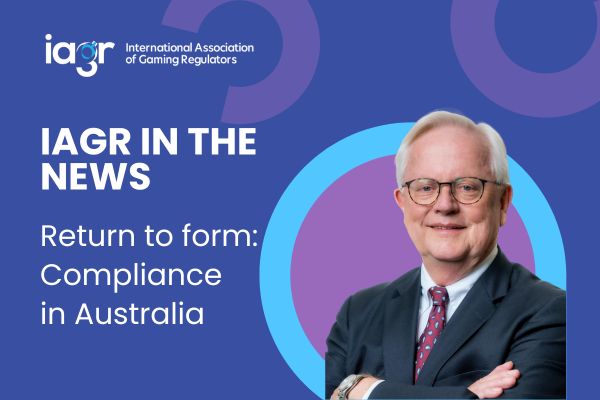
By Philip Crawford, Chief Commissioner of the NSW Independent Casino Commission and member of the Board of Trustees of the International Association of Gaming Regulators
Just a few years ago, the Australian casino industry was making headlines for all the wrong reasons.
The Bergin Inquiry into the suitability of Crown Sydney shocked the nation when it exposed a disturbing culture of non-compliance, widespread governance issues, money laundering and links to organised crime at Crown Resorts casinos in Melbourne and Perth.
Plans to open the doors at Sydney’s newest casino came to a standstill in early 2021 when the Honourable Patricia Bergin SC deemed that the body I was then leading, the Independent Liquor & Gaming Authority (ILGA), should find Crown Sydney unfit to be associated with the restricted gaming licence it had been granted by the New South Wales (NSW) Government in 2014.
Along with this finding, Justice Bergin delivered a further 19 recommendations to improve the regulatory framework for casinos in NSW which included the formation of a dedicated, independent regulator.
At the time, casinos fell under the remit of ILGA, which also held regulatory oversight of the thousands of clubs, hotels, bottle shops and bars across NSW, as well as music festivals and sporting venues where alcohol was sold to the public.
The NSW Government responded to the findings of the Bergin Inquiry with the establishment of the NSW Independent Casino Commission (NICC) the following year, ushering in a new era of casino regulation in Australia.
Such was the urgency to improve oversight of the casino industry in NSW, the NICC was up and running just weeks after changes to the Casino Control Act 1992 were passed through the NSW Parliament.
The NICC became the first dedicated casino regulator in Australia, free from other liquor and gaming responsibilities.
A NEW CASINO REGULATOR
The NICC answered the call for change at Crown Sydney with an intensive, three-year remediation program that involved hundreds of crucial milestones.
We worked closely with the casino while it established an independent subsidiary board for Crown Sydney, appointed new senior executives and reformed its corporate structure.
This remediation program completely transformed the governance, culture, safety and compliance functions at the casino.
Importantly, the findings from the Bergin Inquiry resulted in the banning of high-roller junkets and the prevention of money laundering through the creation of the Financial Crime and Compliance Change Program.
A consequence of these reforms also involved the introduction of more proscriptive gambling harm minimisation measures.
While the clean-up was beginning at Crown Sydney, the findings from the Bergin Inquiry triggered inquiries into casino operations in Victoria and Western Australia.
These later inquiries built on the work and findings of NSW’s Bergin Inquiry and detected further failings in the company’s links to organised crime, as well as a litany of shortfalls in the work Australian casinos needed to do to minimise gambling harms.
In NSW, two further inquiries were then conducted into the operation of Sydney’s only other casino, The Star Sydney, led by Sydney barrister Adam Bell SC.
Trading at Pyrmont on the opposite side of Darling Harbour since 1997, The Star Sydney was found to be operating in breach of the conditions attaching to its casino licence and the law.
Its casino licence remains suspended indefinitely following the first Bell Inquiry in 2022, which identified systemic governance, risk and cultural failures of such gravity that the previous board and executive made a public apology and acknowledged the serious wrongdoing that occurred.
TIME FOR INDUSTRY CHANGE
The Bergin Inquiry did more than just expose criminal behaviours and corporate misconduct – it created a window for change in the regulation of casinos.
It sparked a series of events which required both NSW casinos, and others across the country, to make leadership, governance and operational changes to their businesses in order to convince governments and regulators that they should be allowed to retain their casino licences.
Before Crown Sydney was allowed to open its gaming operations, Blackstone announced a takeover bid for the Crown Group in Australia, which was successful following approval of regulators across Australia.
Blackstone brought to Crown the financial resources and business expertise which have been integral in the rehabilitation of the Crown business and the reinstatement of its casino licences.
In NSW, operating controls on Anti-Money Laundering (AML) and Counter-Terrorism Financing (CTF) are issues on which we have taken a particularly firm stance.
The casino industry can no longer be regarded by organised crime as a facilitator of money laundering activities.
We have no doubt the change enacted by the NICC has now provided a more secure operating environment for the thousands of staff, patrons and tourists who frequent not only these casinos but the surrounding areas every day.
CROWN BACK ON TRACK
In April 2024, the NICC determined that Crown Sydney had sufficiently reformed its business model and was suitable to hold a casino licence.
This has resulted in positive social and economic outcomes for both the casino and the broader Sydney community, including a reduction in crime and gambling harms.
To ensure Crown Sydney can demonstrate a long-term commitment to maintaining suitability the NICC will continue to examine casino operations through regular engagement with staff and management and through regular independent operational audits.
We have also improved the dialogue between the NICC and our stakeholders, which include other state and federal agencies, in particular the Australian Transaction Reports and Analysis Centre (AUSTRAC) and NSW Police.
The Star Sydney, just across the water, is in the process of completing its own remediation plan but is yet to have its casino licence returned.
It will take close and continued regulatory oversight from the NICC – along with its partners in law enforcement, government and community – to ensure both Crown Sydney and The Star Sydney can demonstrate a long-term commitment to suitability.
A MORE COMPLIANT CASINO INDUSTRY
The NICC is immensely proud to have been able to deliver a new level of operational compliance to the casino industry in NSW, Australia and beyond.
By highlighting the issues raised in the Bergin and two Bell inquiries in NSW, we have worked hard to raise the bar for casino regulation in Australia.
The casinos themselves have now recognised these new standards are a must for them to be able to do business in NSW. They have recognised that strict compliance is the only pathway to suitability.
The change we have enacted has forced a cultural transformation and modernised the industry.
Each day following the Bergin Inquiry, it has become clearer that there is much less scope for self-regulation in contemporary casino operations, which will require far greater scrutiny.
It has been a significant undertaking which would not have been possible without the ongoing support of the government and the community.
We know the NICC is not alone in this journey, which is why I look forward to hearing more from other regulators across the world now that I have been appointed to the International Association of Gaming Regulators Board of Trustees.
Together, with greater information sharing between our agencies, we can work towards maintaining an industry which is free from infiltration by criminal elements.